To find polishing machines and deburring equipment for your workshop, start with your actual parts, required finish, and production needs—not a machine catalog. Build a written specification, shortlist suitable suppliers, and require sample-part trials before comparing complete installed costs. This process gives you a practical way to choose equipment without paying for capabilities your workshop will not use.
What do you need before comparing workshop finishing machines?
You need representative unfinished parts, clear acceptance requirements, and a record of your current workload. Material, thickness, cutting method, production volume, and desired finish are key selection factors for a sheet metal deburring machine. Gather these details before requesting recommendations so suppliers can evaluate the same application.
Prepare a simple application file containing:
Material range: Identify each alloy, coating, and protective film that the process must accommodate.
Part dimensions: Record minimum and maximum length, width, thickness, and weight, including small or awkward components.
Incoming condition: Photograph burrs, slag, scratches, and other defects from your actual cutting process.
Required outcome: Specify burr removal, edge rounding, oxide removal, surface appearance, or a combination.
Workload: Record typical batch sizes, repeat orders, changeovers, and current finishing labor.
Acceptance limits: Include drawing requirements, protected surfaces, dimensional tolerances, and approved reference samples.
Do not describe the goal only as “a smooth finish.” Ask your production and quality teams to agree on what an acceptable part looks like and how it will be inspected. Use that definition throughout the buying process.
Follow these steps to find and evaluate suitable machines
Separate edge preparation from surface polishing.
First, identify the operation causing the bottleneck. Deburring removes unwanted material around cut edges; edge rounding and surface finishing are related but distinct operations. Some machine configurations combine them, but that capability depends on the installed processing units.
When evaluating a metal polishing machine, request evidence of the required surface result separately from edge quality. For a sheet metal edge deburring machine, make the edge requirement the primary acceptance criterion. If you need both, require the demonstration to satisfy both on the same part rather than accepting separate showroom samples.
Match the processing method to your incoming parts.
Ask suppliers to explain which tooling removes each defect and which tooling creates the final finish. Abrasive belts, brushes, and dedicated slag-removal units serve different applications; tooling selection also depends on material and the required result. Do not assume one abrasive setup will cover your entire workload.
Request a proposed process sequence for each major part family. Have the supplier identify any preparation needed before the machine and any manual work remaining afterward. This turns a broad claim about sheet metal finishing into a defined production route you can test.
Verify the full usable part range.
Compare more than maximum working width. Request written confirmation of minimum part size, thickness range, permissible weight, flatness requirements, and the holding method for small components. Wide-belt deburring has limitations with large burrs and requires sufficient part evenness for reliable processing.
Send your smallest parts and difficult geometries alongside your largest blanks. Ask the supplier to demonstrate slots, internal contours, narrow features, and any protective film that must remain intact. Treat an untested exception as unresolved—not as an automatic extension of the machine’s advertised capacity.
Choose automation around the complete workflow.
When comparing an automatic sheet metal deburring machine, define what “automatic” includes in the quotation. Ask who loads, unloads, turns, sorts, and inspects the parts. Include all those activities in the production trial rather than timing only the conveyor pass.
Double-sided deburring machines can process upper and lower edges in one operation, avoiding a separate turning step for suitable parts. Single-sided and double-sided configurations should therefore be compared against your actual handling requirements, not treated as interchangeable.
For an automatic flat metal sheet deburring machine, request a batch demonstration from incoming stack to accepted output. Record operator involvement and remaining manual touch-up.
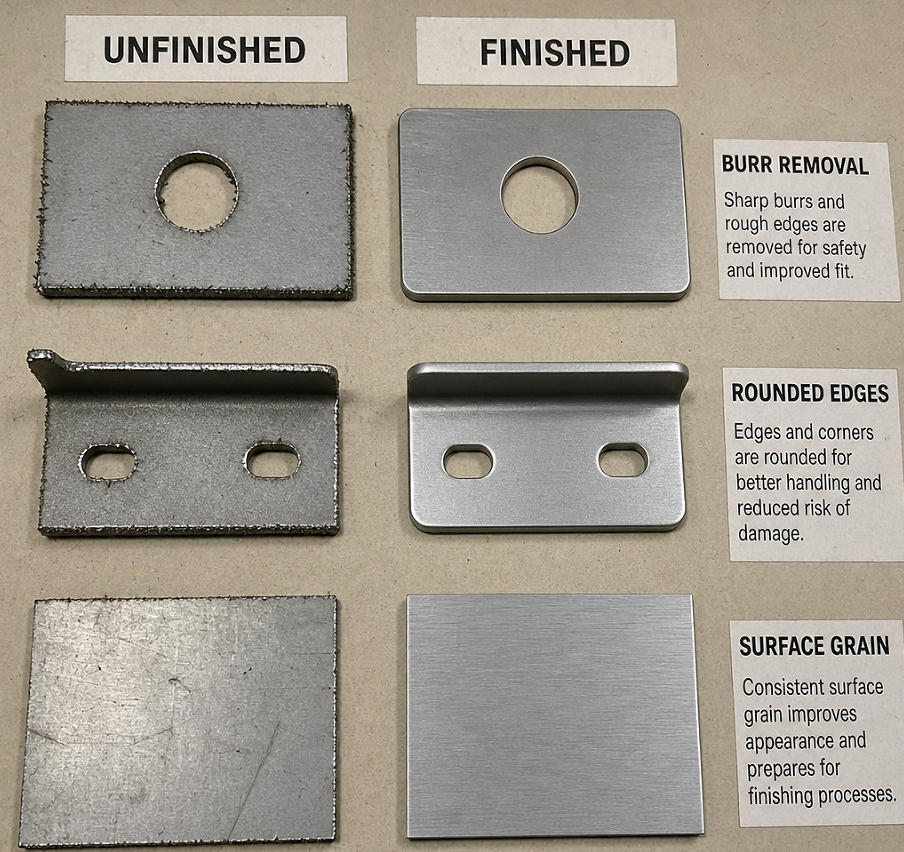
Build a focused supplier shortlist.
Search by application rather than browsing general metalworking equipment listings alone. Useful searches include “deburring machine for sheet metal” followed by your material and part size, or “deburring machine for sheet metal fabrication” followed by the required edge treatment. Use polishing-specific searches when appearance is the principal requirement.
Send the same application file to each candidate and request a written response against it. Ask who provides installation, training, replacement metal deburring tools, and service in your locati0n. Request current lead times and support arrangements directly; do not base a purchase on an old listing or an unanswered inquiry.
Run controlled trials with representative samples.
Require trials before making the final selection. Machine and tooling choice depends on edge requirements, material mix, and desired surface finish; testing actual parts helps verify that combination. ADV, for example, explicitly offers test-part verification for tooling selection.
Label each sample and retain an untreated reference. Include normal production parts, difficult examples, and cosmetic surfaces. Ask the supplier to record the abrasive specification, settings, number of passes, and operator actions.
Inspect the returned parts against your application file. Check accessible and internal edges, critical dimensions, surface appearance, and remaining defects. Request a repeat run if the first result depends on unexplained hand finishing or special preparation.
Check installation and dust-control requirements.
Obtain an installation drawing and utility schedule before committing. Mark loading space, unloading space, maintenance access, and material movement on your workshop layout. Ask for confirmation of electrical requirements and any compressed-air, coolant, drainage, or extraction connections included in the proposed configuration.
Have a qualified specialist assess dust hazards for the actual materials and process. Grinding, buffing, and polishing can generate combustible metal dust, so do not assume an existing collector is suitable merely because it collects visible dust. OSHA identifies these operations among potential combustible-dust sources.
Resolve the safety design before ordering, including collection, housekeeping, and safe maintenance arrangements.
Compare complete costs and document acceptance.
Request itemized quotations for the machine, tooling, extraction, delivery, rigging, installation, training, and commissioning. Ask suppliers to separate essential equipment from optional upgrades. Obtain replacement abrasive prices and service terms for the exact configuration being quoted.
Compare costs using accepted parts rather than advertised throughput. Build your worksheet around:
Operating cost per accepted part = recorded operating costs ÷ accepted parts produced.
Include labor, consumables, utilities, maintenance, and rework in the operating-cost estimate. Keep purchase and installation costs visible separately. Before placing the order, agree on a commissioning trial that repeats the approved sample process and confirms the required result.
What should you do if a trial misses the required finish?
Ask the supplier to identify the cause and repeat the trial under documented conditions before changing your acceptance criteria. Material removal depends on factors including abrasive choice, feed rate, and infeed; those settings must be balanced against the required surface quality. A faster demonstration is not useful if it fails your inspection.
Use the failed sample to guide the next test:
Burrs remain: Ask whether the proposed tooling addresses the incoming burr condition and whether another operation is required.
Edges pass but appearance fails: Request a separate review of the finishing stage and compare the result with your approved reference.
Small parts cannot be processed: Require a demonstrated holding solution or remove those parts from the machine’s approved scope.
Results vary across the batch: Request repeated samples, documented settings, and an explanation of setup and wear checks.
Do not accept “the operator will work it out” as the commissioning plan. Record any limitations and decide whether the remaining manual work still supports the investment.
Complete your final purchase checklist
Before choosing among polishing machines and other metal fabrication tools, confirm that the proposal answers these points:
Your representative parts passed the agreed inspection.
Required manual handling and touch-up are documented.
Installation and dust-control requirements are resolved.
Consumables, training, and service arrangements are quoted.
Commissioning responsibilities and acceptance criteria are written down.
Choose the machine that proves it can perform your required sheet metal processing consistently—not the one with the longest feature list. Keep the approved samples, trial records, and settings as the baseline for installation and future production checks.