

What Is Deburring? Removing Unwanted Material
Deburring is the first line of defense against sharp remnants left by cutting operations. When metal is punched, laser-cut, plasma-cut, waterjet-cut, or sheared, small ridges or spurs—called burrs—form along the cut edges. These imperfections are not just cosmetic; they can:
Cause injuries to workers handling the parts
Interfere with assembly and fit
Damage downstream equipment or tooling
Deburring machines use abrasive belts, discs, or brushes to strip away these burrs efficiently. The process creates smooth, flat edges and prepares the workpiece for subsequent treatments. For high‑volume production, mechanical deburring is far faster and more consistent than manual filing or grinding.
Edge Rounding: Smoothing Edges for Safety and Coating Performance
While deburring removes burrs, edge rounding goes further by reshaping the edge into a radius. This is critical for two main reasons:
Personnel and machine protection – Rounded edges eliminate the risk of cuts during manual handling or assembly. They also prevent damage to conveyors, fixtures, and other equipment that come into contact with the part.
Paint and coating adhesion – Sharp corners cause coatings to thin out or pull away as the paint dries. A rounded edge with a consistent radius allows the paint layer to maintain uniform thickness, preventing peeling, rust, or premature failure.
In sectors such as food processing and pharmaceuticals, health and safety regulations often mandate rounded edges on all metal components.
How Mechanical Edge Rounding Works
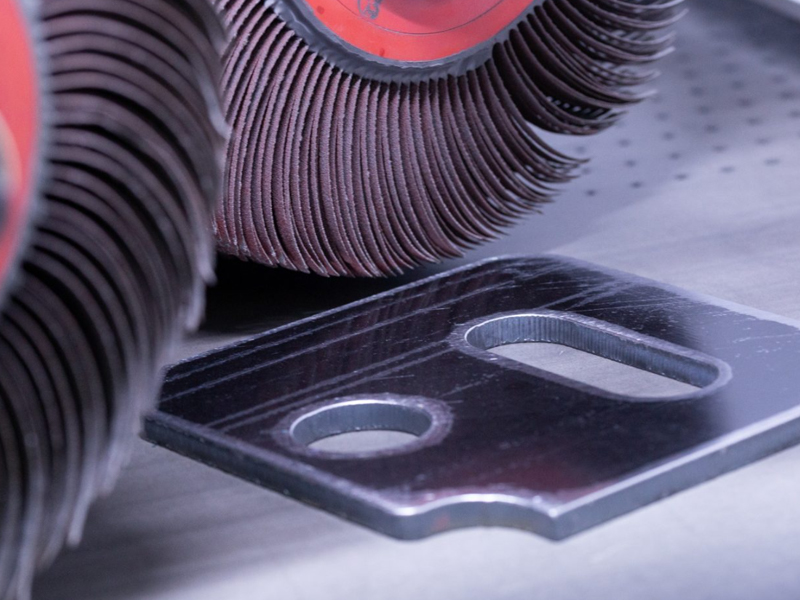
Manual edge rounding with electric grinders is possible, but it is labor‑intensive and highly dependent on operator skill. Mechanical edge rounding automates the process, delivering uniform results every time. Common tooling configurations include:
Multi discs – Counter‑rotating discs that round edges while also refining the surface.
Abrasive rollers – Typically used for deburring, but capable of breaking sharp edges when adjusted correctly.
Rotary brushes – Flexible abrasive flaps mounted on a rotating carousel. These brushes conform to the edge contour, rounding the entire profile without damaging the flat surface. They produce the most consistent radius, up to 2 mm, on various metals (steel, stainless steel, aluminum, zinc, etc.).
Rotary brush machines range from compact 600 mm working‑width units to heavy‑duty 1600 mm models. Some systems can handle parts as small as 50 mm × 50 mm, held in place by contact rollers.
Advantages of Mechanical Edge Rounding
Time and labor savings compared to manual methods
Uniform edge radius for reliable coating and welding
Consistent quality across high volumes
Safer work environment and fewer product rejects
Surface Finishing: Achieving the Desired Texture and Aesthetic
Surface finishing is the final step that defines how the metal looks and feels. It can range from creating a mirror‑like polish to adding a brushed, matte, or textured surface. The main goals of surface finishing are:
Enhancing appearance – A consistent finish improves the product’s perceived value.
Improving corrosion resistance – Certain finishes seal the surface or reduce moisture retention.
Preparing for further treatments – For example, a specific roughness profile may be required before powder coating or adhesive bonding.
Surface finishing equipment includes wide belt sanders, brush systems, Scotch‑Brite units, and polishing machines. Depending on the configuration, a single machine can combine deburring, edge rounding, and finishing in one pass.
Key Differences at a Glance
| Process | Primary Purpose | Typical Tools | Outcome |
|---|---|---|---|
| Deburring | Remove burrs and sharp ridges | Abrasive belts, discs, brushes | Smooth, safe edges (no radius) |
| Edge Rounding | Create a radius on edges | Rotary brushes, counter‑rotating discs, rollers | Consistent radius (0.2–2 mm) for safety and coating |
| Surface Finishing | Achieve desired texture or gloss | Belt sanders, Scotch‑Brite, polishing wheels | Specific surface roughness or appearance |
Choosing the Right Process for Your Application
When Deburring Is Enough
If your parts will not be painted or handled frequently, and the only concern is removing loose burrs that could clog assemblies, deburring alone may suffice. Examples include interior structural brackets or hidden components.
When Edge Rounding Is Necessary
Any part that will be powder‑coated, wet‑painted, or electroplated (to prevent edge pull‑back)
Components handled by workers (guards, handles, food‑contact surfaces)
Parts that move through automated lines (to avoid scratching belts or damaging sensors)
When Surface Finishing Adds Value
Decorative panels, enclosures, or consumer products
Parts requiring a specific friction coefficient or cleanability
Products exposed to corrosive environments (finishes can include passivation or sealing)
Combining Processes in a Single Machine
Modern sheet metal processing lines often integrate deburring, edge rounding, and finishing into one pass. For example, a machine with a deburring belt followed by rotary brushes can simultaneously remove burrs and round edges. Adding a Scotch‑Brite belt at the end produces a final finish. However, for double‑sided edge rounding with a finish, the part may need to be rotated and run through twice.
Manufacturers like ADV offer modular configurations, allowing shops to choose attachments that match their budget and production needs—from basic edge breaking to full radius rounding up to 2 mm.
Conclusion
Deburring, edge rounding, and surface finishing are not interchangeable; they address different quality challenges. Deburring eliminates sharp remnants, edge rounding creates a safe, paint‑ready radius, and surface finishing delivers the final look and feel. By understanding these distinctions and selecting the right mechanical equipment, fabricators can improve worker safety, coating durability, and product consistency—all while reducing manual labor and scrap rates.
Contact Us : Ready to optimize your sheet metal processing? Evaluate your parts’ requirements for edge condition, coating needs, and surface aesthetics to choose the right combination of deburring, edge rounding, and finishing.