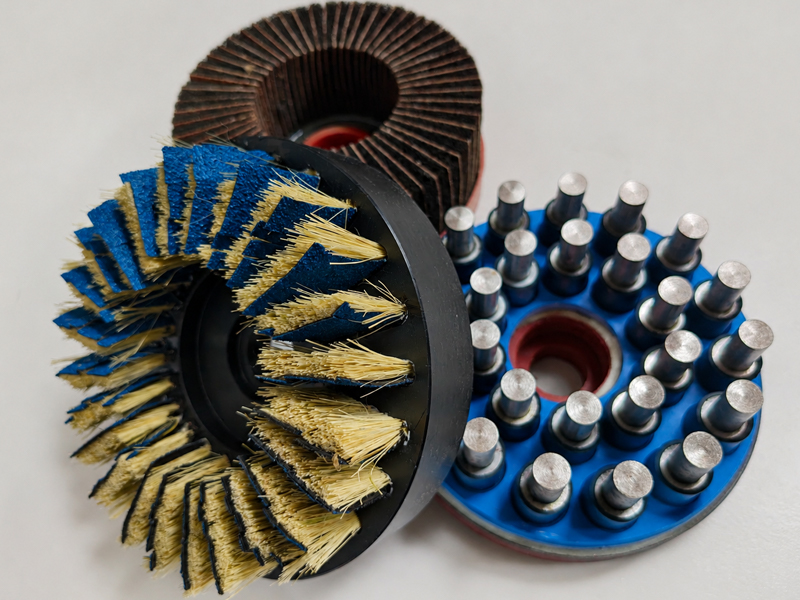
Abrasive disc brushes(x brushes)—remove light burrs and break sharp edges on sheet metal when the working face can physically reach the edge. The result is not governed by grit number alone. Filament construction, contact depth, peripheral speed, feed rate, and tool path all influence how much material is removed and what edge condition remains. This guide translates those variables into an actionable specification sequence, grounded in published brush-deburring practice and standardized edge definitions.
1. Start With the Burr and the Required Edge Condition
Before selecting a brush, inspect parts from the actual cutting or forming operation. Laser-cut edges range from clean to localized dross depending on cut parameters; punching and stamping typically leave a burr on the exit side. Record which side carries the burr, where it occurs, and whether the feature is a thin projection or a thick, firmly attached remnant.
ISO 13715:2017 provides the vocabulary for this assessment: an external edge is considered burred when material overhangs the ideal geometrical shape by any amount greater than zero. That definition is binary—a burr exists or it does not—but the process decision depends on severity and the required end state.
Two distinct outcomes must be separated before setup:
A burr-free part does not automatically possess a specified radius. If the drawing calls for a measurable radius, the inspection method must be capable of measuring it—visual appearance is not sufficient. Heavy dross or firmly attached burrs may require a separate removal operation first; increasing brush engagement to compensate for a heavy burr accelerates filament wear and can alter the edge beyond drawing tolerance.-
2. Grit Is Only One Variable: Read It Together With Filament Construction
ADV supplies abrasive disc brushes in 80, 120, 180, and 320 grit. Within a comparable construction, lower grit numbers provide coarser action; higher numbers are generally considered for lighter finishing. These are selection options, not fixed assignments to a burr size or radius.
Grit designation alone cannot predict performance because filament diameter, exposed trim length, abrasive loading, and face density also determine stiffness and contact behavior. Two brushes marked with the same grit can behave differently. Published brush guidance confirms that coarser grits generally pair with larger filament diameters, producing a less flexible but more aggressive tool.-
Abrasive grain type matters for material compatibility. Silicon carbide is harder and sharper, making it preferred for ferrous metals. Aluminum oxide is less likely to fracture and is preferred for softer metals including stainless steel and aluminum, while also eliminating the risk of free-carbon contamination from silicon carbide on stainless surfaces. Stainless steel work-hardens and tends to gall, so an abrasive that cuts rather than smears is preferred; aluminum loads a brush quickly and benefits from finer grit with more flexible filament.-
3. Set Contact, Peripheral Speed, and Feed as a Coupled System
The rotating filament tips need enough engagement to reach the burr. Too little contact leaves edges unfinished. Excessive engagement bends filaments, raises friction and heat, and shortens brush life. A shorter or stiffer filament resists deflection more than a longer, more flexible one, so contact depth must be established for the selected brush rather than copied from another model.
Peripheral speed. At a given RPM, a larger brush has a higher peripheral speed. Published guidelines converge on a working ceiling rather than a single “best” number:
| Recommended peripheral speed guidance |
|---|
| Stay under 3,500 SFPM as a rule of thumb; maximum safe speed marked on the brush is not the optimum working speed-
|
| Optimal brush speed approximately 3,500 SFPM, balancing cutting efficiency and brush longevity-
|
| Disc speeds under 2,500 SFPM dry, 3,500 SFPM wet; excessive speed causes filaments to flare and bounce off the workpiece-
|
The highest permitted RPM is a safety limit, not a target process setting. Slower feed usually increases dwell at a given edge, but it can also increase material removal or surface marking. Starting feed rates of 30–80 IPM are commonly recommended, with the final value determined by burr size, material, contour, and finish requirement.-
4. Tool Path and Edge Access Decide Whether the Burr Is Removed or Folded Over
The working face must cross every required edge, and the direction of approach must remove the burr rather than fold it over. For disc brushes, the tool path can follow the path of the cutting tool that created the burr, but the brush centerline should be offset from the cutting-tool centerline to increase perpendicular filament contact with the burred edge. Rotating the brush opposite to the direction of the tool that produced the burr is recommended for best results.-
A brush presented to the top face of a part will not automatically reach a burr on the underside. Edges inside narrow slots and deep recesses may require a part turnover, a second brush position, or a different tool format. The self-limiting nature of abrasive nylon brushing is an advantage here: these tools remove burrs preferentially without changing dimensional tolerances on large surfaces, but they are edge-specific and will not compensate for poor access.-
5. Machine Fit and Finished-Part Validation
For an automated station, specify brush outside diameter, working-face width or pattern, mounting interface, available clearance, and replacement access. Dense and segmented faces present different contact patterns; the pattern should be chosen through a part trial, not assumed to cover every edge.
Validation should be run on a representative sample and should inspect:
the worst burr locations;
both sides of the part where required;
surface marking;
any specified edge radius, using an appropriate measurement method.
Edge radius can be verified with optical or stylus profilometry, laser profilometry, or vision-based radius-of-curvature analysis, depending on tolerance and accessibility. Aerospace and other regulated supply chains add a foreign-object-debris (FOD) dimension: cross-hole deburring is a known FOD-risk area, and AS9100D requires documented FOD prevention, tool accountability, and post-deburr inspection.-
Critically, validation must be repeated after reasonable brush wear or adjustment. An accepted result based only on a new brush is not a validated process. If a single pass cannot meet the edge requirement without excessive marking or wear, the process sequence or tool choice should be revised rather than pushing engagement or dwell beyond the brush’s working envelope.
Frequently Asked Questions
Does a higher grit number remove a larger burr more slowly or more quickly?
Within a comparable brush construction, higher grit numbers (finer abrasive) generally remove material more slowly and produce a lighter finish; lower grit numbers are coarser. However, grit is not a substitute for aggressive cutting: a fine abrasive cannot be assumed to remove a substantial burr simply by increasing pressure or dwell time. The starting burr and required finish should drive the trial.-
What is a safe peripheral speed for an abrasive disc brush?
Published guidelines place the working range below 3,500 SFPM, with dry disc applications often held under 2,500 SFPM to avoid filament flaring and bouncing. The maximum RPM marked on the brush is a safety limit, not an operating target.-
Can one disc brush deburr both the top and underside of a sheet-metal part?
Not automatically. The working face must contact the burr-bearing edge. Underside burrs typically require the part to be turned over, a second brush position, or a different tool format. Access limitations should be identified before the brush is specified, not discovered during production.-
Does deburring with an abrasive disc brush create a measurable edge radius?
It can create a small edge radius, but the radius is a process outcome, not a guaranteed drawing feature. Published practice indicates typical radii on the order of 0.001–0.002 in. for hard steel and carbide, and 0.004–0.008 in. for soft materials such as aluminum, with larger radii requiring substantially longer cycle times. If the drawing specifies a radius, that radius must be measured, not inferred from burr absence.-
Why does the same grit perform differently on stainless steel and aluminum?
Grain type and filament construction interact with workpiece metallurgy. Stainless steel work-hardens and may gall under a smearing action; aluminum is soft and loads a brush quickly. Aluminum oxide is often preferred for softer metals, while silicon carbide or ceramic grain may be selected for tougher ferrous work. The same grit number in two different filament constructions can therefore produce different results.-
Information to Send for a Custom Disc Brush Specification
For a new installation or a replacement brush, provide:
Sheet-metal material, part drawing, and photographs or samples showing the burr-bearing edges.
Required outcome—burr removal, edge break, or specified radius—plus inspection criteria and measurement method.
Brush envelope, mounting details, available speed range, feed arrangement, and which faces the tool can access.
Current brush details and trial results, if a replacement is being specified.