Table of contents :
Deburring Equipment introduction
Equipment installation
Pipe connection
Equipment operation
Abrasive recommendation and parameter setting
Replace the abrasive
Equipment maintenance
Common fault analysis
Matters needing attention
Wet dust collector
Equipment introduction
Equipment principle
This metal deburring machine is a combination of dry abrasive belt and rotary brush. Mainly used to deal with deburring, chamfering function workpiece edge, hole edge deburring and chamfering treatment.
This equipment is a pass-through processing equipment. First, burrs such as slag particles and flanging on the surface of the workpiece are removed through a set of wide abrasive belt mechanisms. Equipped with a set of rotary brush structure, the rotary brush rotates at high speed and beats the surface of the workpiece, so that the contour edges around the workpiece surface and in the hole are smooth and rounded, resulting in an R angle effect. For the burrs generated in the process of stamping, shearing, laser cutting, plasma cutting, etc., it can be removed in all directions at one time, so that all edges and holes of the workpiece can achieve a small R arc effect. The processing process is safe and reliable, so that the workpiece can achieve perfect results.
The independent operation of the abrasive belt station can achieve the effects of brushing, polishing, descaling, and slag deburring on the surface of the metal sheet; the independent operation of the rotary brush can achieve 360-degree deburring without dead ends. This equipment adopts high-damping imported conveyor belt to convey workpiece, frequency conversion speed regulation, conveying platform with adsorption device.
Device parameters
1 | Worktable width | 800mm |
2 | Processing thickness | 0.5-100mm |
3 | Feeding speed | 0.5-6m/min(Frequency conversion adjustable) |
4 | Abrasive belt speed | Constant speed |
7 | Maximum power | 34.9KW |
8 | Rated voltage | AC 380V/50Hz |
9 | Weight | 3000kg |
10 | Mainframe size | 3100*1750*2380mm |
Deburring Equipment installation
The project department is responsible for the overall layout, formulating corresponding installation measures, and controlling the on-site installation process to ensure that the equipment installation process meets the requirements of the specification; the on-site operator is responsible for the general layout and installation; the quality control is responsible for the installation quality process and control, quality supervision and acceptance.
Use range
Applicable to our company's processing and manufacturing of ADV508-RW800 models.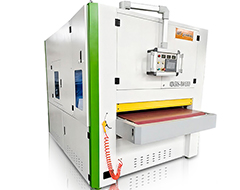
Construction sequence
All equipment and spare parts must be installed in strict accordance with the design and construction drawings and process layout drawings.
Before installing the equipment, first level the foundation and mark the installation benchmark; confirm that the equipment is placed on a level and firm ground, and the ground level deviation is required to be less than 5mm;
ADV508-RW800 metal deburring machine is divided into three parts, namely deburring machine, adsorption fan, wet dust collector (optional for dust collector). Among them, the weight of the deburring machine is about 2.3T, the weight of the adsorption fan is about 200KG. Note: The deburring machine should be transported by a forklift of more than 4 tons, and placed in the designated position slowly and steadily to prevent impact and affect the accuracy of the equipment. Adsorption fans and wet dust collectors can be moved directly by manual hydraulic trucks. Before placing the equipment, place a rubber shock-absorbing pad under the feet, and adjust the ground screws at the bottom of the equipment to fix it. A bubble level is placed on the conveying platform, and the anchor screw can be adjusted until the bubble is level.
Pipe connection
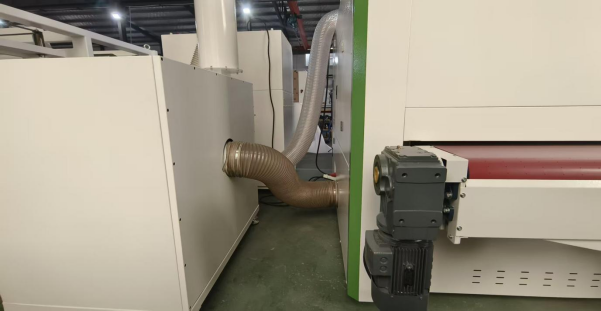
Connect the vacuum cleaner with a φ200mm pipe. Based on the actual installation layout, measure and cut the required dimensions for corrugated hose-1 and corrugated hose-2.
The wire hose-1 is connected to the main machine's top suction port connector at one end and to the dust collector's air duct connector box at the other end, with both ends secured by a clamp.
The wire hose-2 is connected to the air duct joint box at one end and to the muffler at the other, with both ends secured by a clamp.
Equipment operation
The equipment should be operated by qualified personnel who must wear masks and gloves. It is forbidden to open the door of the electric box and the side door of the main engine during the operation of the equipment. When replacing parts of different specifications, the first piece of trial processing should be carried out, and various parameters should be adjusted when necessary to achieve the best processing effect.
Turn on the power. Turn on the power switch of the electric cabinet, turn on the control power button on the control panel, and the equipment is closed. (Turn on the main power to control the power button, the indicator light is off, and the indicator light is on when you click it.)
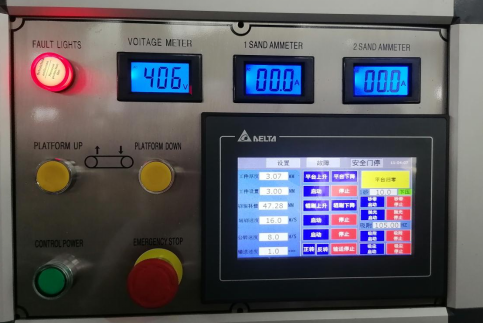
After the parameter setting is completed, click: Conveying forward rotation-revolution start-rotary brush start-abrasive belt start-adsorption fan start
Note: Do not turn off the power directly when the device is running. The equipment will automatically stop when the equipment fails, and the fault alarm code will be displayed on the display screen. And accompanied by an alarm sound prompt!
Parameter settings
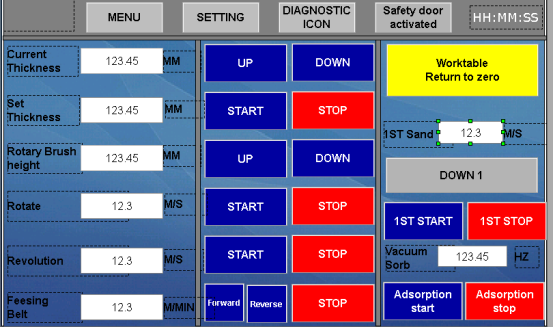
Turn on the main power of the electric box, click the control power supply, the equipment is closed, and click the touch screen to set the parameters.
Click the workpiece setting 1-100mm to input the actual thickness of the workpiece.
According to the weight requirements of the workpiece, input the appropriate rotary brush compensation 1-55mm and rotary brush speed 9-20m/s and revolution speed 8-12m/s.
According to different abrasives and different brushing and chamfering effects, choose the appropriate conveying speed 1-8 m/min. When choosing abrasive belt brushing, the feeding speed should preferably be above 5 m/min. When choosing rotary brush for rounding, the feeding speed should be preferably below 2.5m/min.
After all parameters are set, place the workpiece above the conveying, click "Conveying Forward" to convey the workpiece under the abrasive belt, manually pull the abrasive belt, and observe whether the abrasive belt is ground to the surface of the workpiece, if the abrasive belt is not ground to the surface of the workpiece, Click the platform to rise "Platform rise" rises 0.2mm per click. Because the thickness of the workpiece will change, it must be ensured that the abrasive belt cannot be raised more than 0.3 at a time.
Click the up button one by one to manually pull the abrasive belt until the abrasive belt is ground to the workpiece surface. Just go up to the surface of the abrasive belt and scrape the surface of the workpiece. (If the platform rises too much, the abrasive belt cannot be pulled manually, and the platform rises too high and wears too much, which will easily damage the conveyor belt.)
Then adjust the rotary brush compensation, the initial position of rotary brush compensation is 0.00mm, according to the required size of deburring and chamfering, increase 1-2mm. The larger the value, the larger the inverted R angle. The rotary brush will be worn down later. If the deburring and chamfering effect is not good, increase 1mm. Change to a new rotary brush when it increases to 55mm.
Abrasive recommendation and parameter setting
For deburring
Workpiece material | Burr height | Abrasive belt grit # | Rotary brush grit # | Conveying speed(m/min) |
Carbon steel plate | 0.1-0.5mm | 80-180# | 80#-180# | 2-5 |
0.5-1mm | 60-120# | 80#-120# | 1-5 |
Stainless steel plate | 0.1mm-0.5mm | 80#-240# | 120#180# | 2-5 |
0.5mm-1mm | 80-180# | 120#180# | 1-5 |
Copper, aluminum plate | 0.1mm-0.5mm | 120-180# | 120-240# | 3-8 |
0.6mm-1.5mm | 80-180# | 120#180# | 3-5 |
For brushing
Workpiece material | Burr height | Abrasive belt grit | Conveying speed(m/min) |
Stainless steel plate | 0.1-0.5mm | 120-180# | 3-5 |
Copper, aluminum plate | 0.1-0.5mm | 120-240# | 3-5 |
For chamfering
Workpiece material | Burr height | Abrasive belt grit | Conveying speed(m/min) |
Stainless steel plate | 0.1-0.5mm | 120-180# | 1-2 |
Copper, aluminum plate | 0.1-0.5mm | 120-240# | 1-3 |
Replace the abrasive
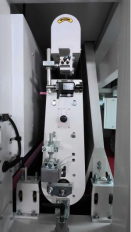
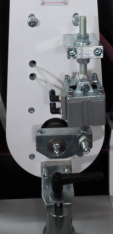
First loosen the abrasive belt tension switch, lower the platform, the workpiece thickness indicator shows the 30.00 position, then remove the abrasive belt locking block, lift the knob up, and turn it clockwise.
After replacing the new abrasive belt, fix the locking block first, place the abrasive belt in the middle of the support roller, and then tighten the abrasive belt.
Equipment maintenance
The full cost benefit of your deburring equipment can only be achieved with frequent preventive maintenance to eliminate potential hazards that could lead to failure before it occurs. When new equipment is installed, you will need to establish a preventive maintenance schedule to ensure maintenance and overhaul work as planned.
When opening the machine for maintenance, it is necessary to shut down the power supply first.
When you stop deburring, please reset the device, do not directly power off and shut down.
It is strictly forbidden to scrape the belt with hard objects with edges and corners, so as not to damage the rubber surface and affect the use.
Common fault analysis
Buzzer light indication
Abnormal or the sensor triggers an alarm, the fault light is on (return to the original state after the sensor alarm is released).
For example: The abrasive belt deviates, the fault light is on, and the original state is restored.
The abrasive belt deviation
If the abrasive belt is used for a long time, the overall circumference of the abrasive belt will be elongated, and the abrasive belt will deviate.
Common Troubleshooting Table
NO. | Common faults | Failure analysis | Solution |
1 | Fault light alarm | Whether all emergency stop switches have been pressed | Unplug all emergency stops |
Whether the limit photoelectric is triggered | Check if the photoelectric is blocked |
2 | Workpiece slump | The pressure roller is pressed too hard | Adjust the pressure roller |
Excessive pressure on the abrasive belt | Adjust the height of the abrasive belt |
Equipment structure and features
When dust-laden gas is drawn into the dust collector's inlet chamber by the fan, the airflow turns downwards and impacts the water surface, causing some larger dust particles to fall directly into the water. As fine dust particles pass through the S-shaped narrowing channel between the upper and lower impellers, the airflow velocity increases. When the airflow impacts the water surface, it carries water along with it, creating a large amount of water droplets and fine mist, ensuring thorough contact between water and air. Within the S-shaped narrowing channel, the sudden change in airflow creates centrifugal force, throwing the dust particles against the outer wall, where the fine particles are effectively captured by the water mist. After leaving the S-shaped narrowing channel and entering the clean air misting chamber, the airflow velocity decreases, and the water mist is centrifugally separated by the baffle plate, washing the dust particles. The water and air are further thoroughly mixed, and most of the fine dust particles are captured by the water droplets and sink into the water, returning to the water storage tank. The purified gas is de-watered by the baffle plate in the misting chamber and then drawn out by the fan, while the sludge is discharged periodically or continuously through the sludge discharge valve.
Troubleshooting and troubleshooting methods
Fault characteristics | Cause of the fault | Elimination methods |
Dust collector not working | The factory voltage fluctuates too much, resulting in undervoltage or overvoltage | Factory internal negotiation to resolve |
Excessive current caused the thermal overload protector to trip | The motor needs to be checked; it may have tripped due to thermal overload |
Abnormal running resistance | Liquid level too high/low | Regulate water level |
The process system is not working | Resumption of work |
Insufficient suction | Dust collector pipes are clogged or damaged | Clean or replace |
Dust accumulation | Timely sewage discharge |
Liquid level too high | Lower water level |
The motor wires are connected in reverse | Any two of the three UVW lines can be swapped |
Excessive emission concentration | Dust concentration too high | Reduce inhaled dust concentration |
Low liquid level | Raise water level |
Filtered water saturation | Regularly drain sewage and change water |
Note: If the dust collector malfunctions or its actual operating conditions differ significantly from the original design conditions, please contact our company promptly for a solution.
If you have any questions pls contact us now ! - Deburring solutions