Beyond aesthetics — understanding how advanced deburring secures fatigue life, assembly precision, and operational safety across metalworking, aerospace, and automotive sectors.
Machining operations — milling, turning, punching, laser cutting, or stamping — inevitably introduce unwanted material protrusions known as burrs. While a burr may appear negligible, its presence compromises dimensional accuracy, accelerates corrosion, and creates stress risers that lead to premature component failure. As secondary operations grow more critical in high-mix, low-volume production, deburring has evolved from a manual afterthought into a sophisticated, technology-driven discipline. This guide dissects deburring methodologies, material considerations, and the machinery that defines modern edge finishing. Drawing from decades of process engineering insight, we also examine how tailored equipment — such as systems from ADV Machine — addresses the industry's most persistent burr-removal challenges.
Defining Deburring: A Secondary Process with Primary Consequences
Deburring refers to the controlled removal of burrs, sharp edges, or fins that remain on a workpiece after primary shaping or cutting. These imperfections arise from plastic deformation, material tearing, or tool exit marks during processes like shearing, blanking, drilling, and bending. Deburring is not merely cosmetic; it is a functional necessity that restores the designed edge condition and surface integrity.
In technical terms, a burr can be classified by its formation mechanism — Poisson burr, rollover burr, tear burr, or cut-off burr. Regardless of type, the goal of deburring is to eliminate these features without altering critical tolerances or inducing secondary stress. The method selected must align with the component's material (ferrous, non-ferrous, plastic, composite), geometry, and the required edge radius or break.
Why Burr Removal Is Non-Negotiable in Engineered Components
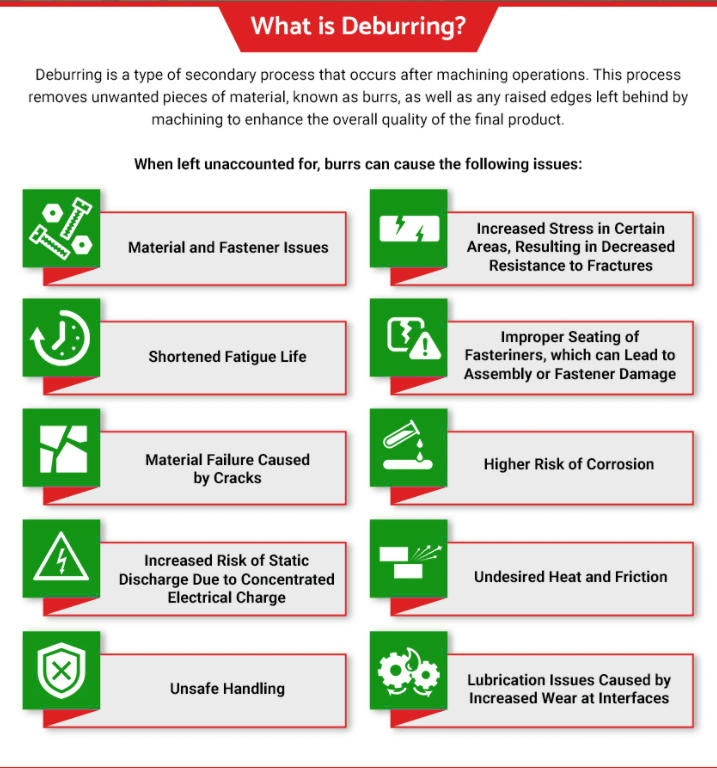
The downstream effects of unremoved burrs extend far beyond poor fit-up. Industry case studies and failure analysis consistently link burrs to:
Accelerated fatigue cracking: Burr roots act as micro-notches, concentrating stress and drastically reducing fatigue life in cyclic loading applications (e.g., turbine blades, suspension components).
Galvanic corrosion and crevice attack: Burr pockets trap moisture and electrolytes, initiating pitting and crevice corrosion even on passivated stainless steels.
Fastener and assembly failure: A burr under a bolt head or within a threaded hole leads to false torque readings, joint relaxation, and eventual fastener loosening.
Electrical and thermal anomalies: Sharp burrs can concentrate electrical charge, increasing static discharge risk in electronics enclosures; they also generate hot spots due to increased friction.
Lubrication disruption: Burrs in fluid passages or bearing journals abrade seals and alter oil film thickness, leading to premature wear.
Personnel hazard: Sharp edges pose laceration risks during handling and assembly — a major OSHA concern.
For these reasons, deburring specifications are now explicitly mandated in ISO 13715, ASME Y14.5, and various aerospace primes' engineering standards.
Comprehensive Survey of Deburring Techniques
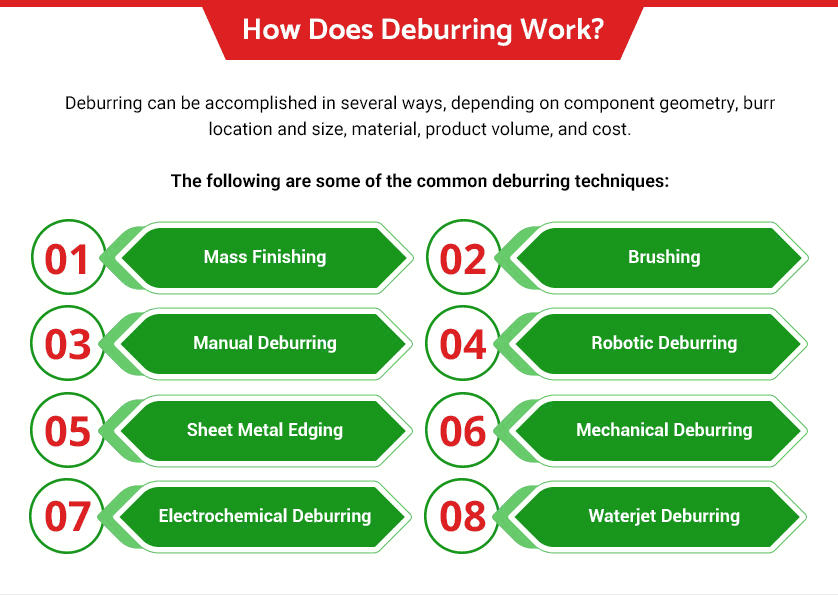
No single deburring method suits every application. The selection matrix weighs production volume, burr location (internal/external), material hardness, and allowable edge condition. Below is a structured overview of established processes, each with distinct operational envelopes.
Mass Finishing
Utilizes vibratory bowls, centrifugal discs, or drag finishers with abrasive media to process batches of components. Ideal for small to medium parts with moderate burr size. Dry or wet compounds enhance surface refinement. Frequently employed for fasteners, stampings, and sintered parts.
Rotary wire brushes or abrasive-impregnated nylon filaments mechanically scrub edges. Effective for linear edges, gear teeth, and cross-hole deburring. Offers directional control and is often integrated into CNC machining centers for in-situ deburring.
Hand tools, files, scrapers, and pneumatic grinders remain prevalent for low-volume or highly complex geometries. While flexible, it introduces variability and ergonomic concerns. Often reserved for rework or prototype development.
Robotic Deburring
6‑axis robots equipped with compliance tools and force sensors deliver consistent edge breaks on large castings, weldments, or aerospace structures. Programmability ensures repeatable chamfer dimensions regardless of operator skill.
Specialized edge rounding machines with pinch rollers or oscillating belt heads process sheet stock from 0.025" to 0.25" thick. Removes shear burrs and conditions edges for subsequent forming or painting.
Mechanical Deburring
Dedicated machines using rotating brushes, belts, or discs. While less adaptable than manual methods, mechanical systems excel in high-volume production with consistent part orientation. Examples include wide-belt sanders configured for edge radiusing.
Electrochemical Deburring (ECD)
Anodic dissolution precisely removes burrs from internal intersections or blind holes without mechanical stress. A shaped cathode and electrolyte (typically sodium nitrate or glycol-based) erode burr material. Unmatched for fuel system components and hydraulic manifolds.
Waterjet Deburring
High-pressure water (up to 60,000 psi) with or without abrasive erodes thin burrs and feather edges. Ideal for delicate parts or where thermal influence must be avoided. Frequently used on machined plastics and thin-wall tubing.
Each method entails trade-offs in capital cost, cycle time, and edge radius control. For instance, electrochemical deburring delivers micron-level precision but requires electrolyte management, while mass finishing offers low cost per part but may round sharp corners excessively.
Process Selection Criteria: Engineering the Right Edge
When establishing a deburring protocol, manufacturing engineers evaluate several interdependent factors:
Material characteristics: Aluminum demands different abrasives than Inconel; plastic burrs may require cryogenic treatment or flame deburring (outside this scope).
Burr location and accessibility: Internal cross-holes often necessitate ECD or thermal methods, while external edges are amenable to brushing or robotic solutions.
Production throughput: Batch-oriented mass finishing excels for high volumes; robotic cells suit moderate volumes with high mix.
Edge specification: A broken edge (0.1–0.3 mm) differs from a controlled radius (R0.5+). Processes must not alter adjacent critical surfaces.
Contamination sensitivity: Aerospace and medical sectors restrict certain media residues; aqueous or dry systems are chosen accordingly.
A robust deburring strategy often combines two methods: bulk removal via mechanical means followed by precision edge honing with brushing or ECD.
Equipment Focus Addressing Small-Part & Mixed-Volume Challenges with ADV Machine
In many job shops and OEMs, the deburring bottleneck arises from the need to process parts as small as 3" × 3" alongside larger workpieces without dedicated changeover. ADV Machine's deburring systems are engineered to bridge this gap. A distinctive conveyor design incorporates a high-friction belt that securely transports miniature components that would otherwise slip or fall between belt seams. Simultaneously, an integrated scuffing mechanism cleans the belt surface, preventing abrasive buildup that could mar subsequent parts.
Dual 4‑inch dust ports actively evacuate swarf and debris, maintaining a clean work zone and extending consumable life. Depending on the model, these machines are configured with heavy-duty structural frames, motorized abrasive belt oscillation, air-loaded pinch rolls for consistent pressure, and multi-head frames that accommodate both drum and brush operations. Such versatility enables a single platform to handle a broad spectrum of materials — from mild steel and aluminum to stainless and copper alloys — with repeatable edge quality. For operations seeking to reduce manual deburring labor and improve first-pass yield, equipment with this degree of adaptability becomes a strategic asset.
Key configurations include: dual in-feed/out-feed pinch rolls, paper media filtration for coolant recirculation, and variable-speed abrasive heads to tailor stock removal rates.
Industrial Domains Reliant on Precision Deburring
While nearly every discrete manufacturing sector employs deburring, the following industries maintain exceptionally stringent standards:
Aerospace & Defense: Burrs on hydraulic valve bodies or landing gear components are unacceptable; ECD and robotic deburring dominate.
Automotive Powertrain: Transmission gears, bearing journals, and fuel rails require consistent edge conditioning to ensure assembly automation and longevity.
Medical Devices: Implants and surgical instruments demand burr-free surfaces to prevent tissue trauma and biofilm adhesion.
Electronics Enclosures: Sheet metal cabinets and heat sinks are deburred to prevent wire chafing and ensure EMI gasket contact.
Fluid Power: Manifold cross-drilled passages are electrochemical deburred to avoid contaminant entrapment.
Additionally, woodworking and composites industries employ similar edge-breaking principles to prevent delamination and improve finish adhesion.
Future Trajectory: Automation and Edge Quality Assurance
The deburring landscape continues to shift toward in-process measurement and adaptive control. Force-sensing robotic end-effectors, paired with vision systems, can now map burr variation and adjust toolpath in real time. Likewise, advancements in ceramic and superabrasive media extend tool life in challenging alloys. As tolerances tighten, the integration of deburring into the digital thread — with traceable edge condition data — will become standard practice.
Manufacturers that treat deburring as a value-adding finishing science rather than a cost center gain measurable advantages in part reliability, warranty reduction, and customer satisfaction. Equipment that delivers consistent results across small and large geometries, like those offered by ADV Machine, exemplifies the practical engineering required to meet these evolving demands.