Maximum Deburring Power for Laser Cut Parts: The 508RRWFW® 1300 Series
One pass, both sides, hard burrs eliminated — consistent edge rounding for superior coating and corrosion protection.
The industrial sheet metal processing sector has faced relentless pressure for years: rising quality expectations, higher throughput demands, more complex part geometries, and the urgent need for leaner manufacturing workflows. These forces have pushed technology forward, especially in fiber laser cutting. Fiber lasers now deliver unmatched precision and cutting speed, enabling fabricators to achieve edge quality levels that were once difficult to attain. Yet every advantage brings a counterpart — in this case, a new generation of tenacious, hard burrs along cut edges that challenge conventional deburring equipment. Traditional methods often require multiple passes, part flipping, or manual rework, draining productivity and raising costs. This is where the 508RRWFW® 1300 Series deburring machine redefines the rules: engineered specifically for fiber laser cut components, it combines deburring, edge rounding, and double-sided processing in a single pass — delivering a quantum leap in efficiency and edge quality.
The Hard Burr Challenge: Why Fiber Laser Cutting Changes the Game
Fiber laser cutting uses highly concentrated energy to melt and vaporize metal at exceptional speeds. While this produces narrow kerfs and smooth cut faces, the rapid heating and cooling cycle often creates adherent, hardened burrs along the bottom edge of the workpiece. These burrs differ significantly from those produced by CO₂ lasers or punching; they are tougher, more abrasive-resistant, and can be difficult to remove with standard brushing or tumbling equipment. In practice, many deburring machines struggle to eliminate these burrs without multiple passes or aggressive belt pressures that risk altering part geometry.
The operational impact is tangible: operators often need to rerun parts two or even three times, flip components manually, or resort to hand finishing for critical edges. Such workarounds increase cycle times, create bottlenecks, and introduce variability into the finishing stage. Moreover, inconsistent edge quality directly affects downstream processes — paint adhesion, powder coating uniformity, and corrosion protection all depend on clean, uniformly rounded edges. Without reproducible edge preparation, manufacturers face higher rejection rates, rework costs, and potential field failures. The industry urgently needed a solution that tackles hard burrs head-on without compromising throughput or repeatability.
A Fresh Approach to Edge Processing: Meet the 508RRWFW® 1300 Series
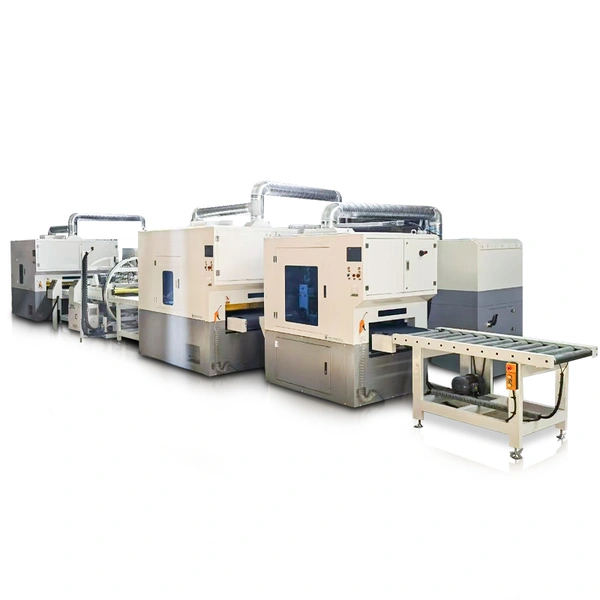
Rather than adapting existing designs, the 508RRWFW® 1300 Series introduces a completely reimagined concept for post-processing fiber laser cut parts. Instead of focusing solely on burr removal, it integrates three critical operations into one seamless workflow:
Deburring – aggressive yet controlled removal of hard burrs from both edges.
Edge rounding (radius generation) – creating consistent, smooth transitions that eliminate sharp corners.
Double-sided processing in a single pass – top and bottom edges finished simultaneously without flipping the workpiece.
This triple-action design directly addresses the pain points of high-volume production. Where conventional solutions require parts to be sent through the machine, manually turned over, and run again, the 508RRWFW® 1300 completes the entire edge preparation in one linear pass. For manufacturers processing thousands of parts per shift, eliminating the flip operation saves hours of labor, reduces handling damage risks, and slashes work-in-progress inventory. The result is a much more efficient process that preserves consistent component quality for subsequent coating, welding, or assembly steps.
High-Performance Tools Engineered for Demanding Applications
Machinery architecture alone cannot guarantee superior results — the abrasive tools play an equally vital role. The 508RRWFW® 1300 Series employs heavy-duty abrasive belts specifically selected to withstand and remove the hardest burrs generated by fiber laser cutting. These belts maintain aggressive cutting action while delivering a controlled surface finish, ensuring that even heat-affected zone residues are eliminated without damaging the base material.
Flexibility is another hallmark of modern production, and the machine delivers it through the ADV quick-change system. Operators can replace abrasive belts and contact rollers in seconds, without any tools. This tool-free changeover allows job shops and high-mix manufacturers to switch between different material types, thicknesses, and edge requirements with minimal downtime. Whether processing thin-gauge stainless steel enclosures or thick mild steel brackets, the quick-change system keeps the machine running productively.
Intelligent Automation: Automatic Wear Compensation & ADV Assistance System
Consistency separates world-class finishing from variable, unreliable output. As abrasive belts wear, their material removal rate gradually decreases, potentially leading to under-processed edges if not corrected. The 508RRWFW® 1300 addresses this with automatic wear compensation. The machine continuously monitors abrasive consumption and adjusts processing parameters — such as belt pressure or contact roller position — in real time. This closed-loop control ensures that every part, whether processed at the start or end of a belt’s life, receives identical deburring intensity and edge radius.
Beyond hardware intelligence, the machine incorporates the ADV intelligent assistance system. ADV simplifies operation by automatically suggesting optimal settings for the deburring process based on part material, thickness, and edge condition. Operators no longer need extensive trial-and-error or deep technical expertise to achieve perfect results. The system guides setup, recommends adjustments for changing geometries, and helps less experienced staff achieve professional-grade edge finishing. By merging mechanical robustness with digital assistance, the 508RRWFW® 1300 reduces operator dependency while maximizing process reliability.
Superior Paint Coating Quality and Corrosion Protection
The true value of edge processing becomes evident during downstream finishing. Sharp, irregular edges cause paint to pull back (a phenomenon known as "edge pull") or result in insufficient film thickness at corners. These defects become initiation points for corrosion, reducing product lifespan and leading to warranty claims. Targeted edge rounding — precisely what the 508RRWFW® 1300 delivers — creates clean, uniform edge profiles that promote even paint flow and optimal coating adhesion. The result is a durable, corrosion-resistant surface that meets automotive, industrial, and architectural standards. For manufacturers supplying painted or powder-coated components, consistent edge quality directly translates into fewer rejects, less rework, and stronger customer confidence.
Which Industries Benefit Most from the 508RRWFW® 1300?
The machine’s design targets any environment where fiber laser cutting is prevalent and edge quality is non-negotiable. Typical adopters include:
Metal fabrication companies – general job shops and high-mix fabricators seeking to automate deburring and reduce manual touch labor.
Automotive suppliers – producing chassis brackets, motor mounts, battery enclosures, and structural components requiring consistent edge radii for welding and e-coating.
Mechanical engineering firms – manufacturing machine frames, guards, and precision parts where sharp edges pose safety risks and interfere with assembly.
Manufacturers of enclosures and electrical cabinets – needing smooth, burr-free edges for safe handling and powder coat adhesion.
Contract manufacturers / job shops – serving diverse customers with varying material grades and thicknesses; the machine’s flexibility and quick changeover are major assets.
Wherever high demands are placed on edge uniformity, processing speed, and downstream coating performance, the 508RRWFW® 1300 Series demonstrates its capabilities — transforming a necessary finishing step into a competitive advantage.
Evaluating the Fit for Your Production Environment
Deciding whether a deburring solution matches your specific requirements involves analyzing burr severity, throughput needs, and quality targets. The 508RRWFW® 1300 Series is explicitly engineered for fiber laser cut components that produce hard, stubborn burrs. If your current process requires multiple passes, frequent part flipping, or inconsistent edge results that cause coating failures, this machine offers a clear upgrade path. Its automatic wear compensation and ADV assistance system ensure reproducible outcomes even with less experienced operators, while the tool-free quick-change system keeps changeover times to a minimum. For manufacturers aiming to scale production without adding labor costs, the one-pass double-sided design can be transformative.
To determine suitability, consider running sample parts through the 508RRWFW® 1300. Evaluate edge radii consistency, burr removal completeness, and cycle time reduction versus existing methods. Many users report cutting deburring time by more than half while achieving edge quality that meets ISO and customer-specific standards. The machine does not merely remove burrs — it creates a foundation for reliable, repeatable downstream processing.
Conclusion: Redefining Edge Finishing for the Laser Era
Fiber laser cutting has revolutionized sheet metal fabrication, but its hard burr byproduct demands a new class of finishing technology. The 508RRWFW® 1300 Series answers that call with an integrated approach: deburring + edge rounding + double-sided processing in a single pass. Backed by high-performance abrasive belts, tool-free quick-change versatility, automatic wear compensation, and the ADV intelligent assistance system, the machine delivers uniform, reproducible edge quality at speeds that keep pace with modern laser cutting cells. For metal fabricators, automotive suppliers, job shops, and enclosure manufacturers, this translates into lower processing costs, improved paint adhesion, reliable corrosion protection, and ultimately higher customer satisfaction. As production demands continue to rise, adopting a purpose-built deburring solution like the 508RRWFW® 1300 Series is not just an operational improvement — it is a strategic necessity for staying competitive.